
Dismantling old beliefs
Over my many years in the beauty and skincare industry, I’ve heard my fair share of myths, misconceptions and — let’s be honest — plain old marketing hype.
The strange thing about a beauty myth is how stubborn it can be. Even when evidence says otherwise, we often cling to what we’ve always believed. Sometimes it’s habit, sometimes it’s hope, and sometimes it’s because every ad, influencer and glossy magazine keeps telling us the same story. So why wouldn’t we believe it?
And it’s not just beauty. We have long-held beliefs about ageing (“I’ll age just like Mum did”), about health (“disease is inevitable”), and about food and nutrition (don’t get me started). But today, I’m bringing the focus back to skincare and beauty myths — six that have been hanging around far too long.
Myth #1: The cleanser you choose doesn’t matter
Some people believe cleanser is just a quick wash-off step, so why invest much thought or money into it? And, while there’s no need to blow the budget on your cleanser, the truth is, your choice of cleanser is one of the most important decisions you’ll make for your skin.
A harsh or poorly formulated cleanser can disrupt your skin’s acid mantle — that fine, protective layer that helps maintain the skin’s protective barrier. Do this once in a while, and your skin may recover. Do it every day, and you’re setting yourself up for dehydration, irritation, barrier damage and eventually sensitive skin that fails to respond to skincare.
Choose a cleanser that suits your skin type and current condition. A simple test? If your face feels tight or “squeaky clean” after washing, it’s a sign your cleanser is stripping too much.
For me, the perfect cleanser should leave my skin feeling soft, comfortable, and ready for the next step — not desperate for moisture.
Myth #2: You need a toner
Toners have been sold as everything from astringents and pH balancers to refreshing mists and treatment waters — but most are unnecessary. Harsh, alcohol-based versions strip the skin and can make oiliness worse, while fragranced “refreshing” formulas risk irritation without real benefit.
The only ones worth considering are those that actively improve your skin: gentle exfoliating toners to boost cell turnover, hydrating toners to plump and prepare the skin for serums and creams, and microbiome-supporting formulas that help keep the skin barrier strong.
If it doesn’t do one of these jobs, you can happily skip it.
For me, a hydrating toner supported with niacinamide is the ideal post-cleansing step.
Myth #3: You must have a separate eye cream
Eye creams exist because we think we need them — and the industry is happy to oblige. In truth, most good serums and moisturisers already contain the actives your eye area needs.
Unless your chosen face product stings near your eyes or you want a formula with SPF that won’t migrate, you can skip the extra jar. Just apply your regular serum or cream sparingly around the orbital bone (not on the lash line or tear duct).
If you love the ritual of an eye cream or enjoy formulas with light-diffusing pigments or cooling applicators, that’s fine — just know it’s a luxury, not a necessity.
For me, an occlusive mask followed by a facial oil works wonders to improve hydration around the eye area.
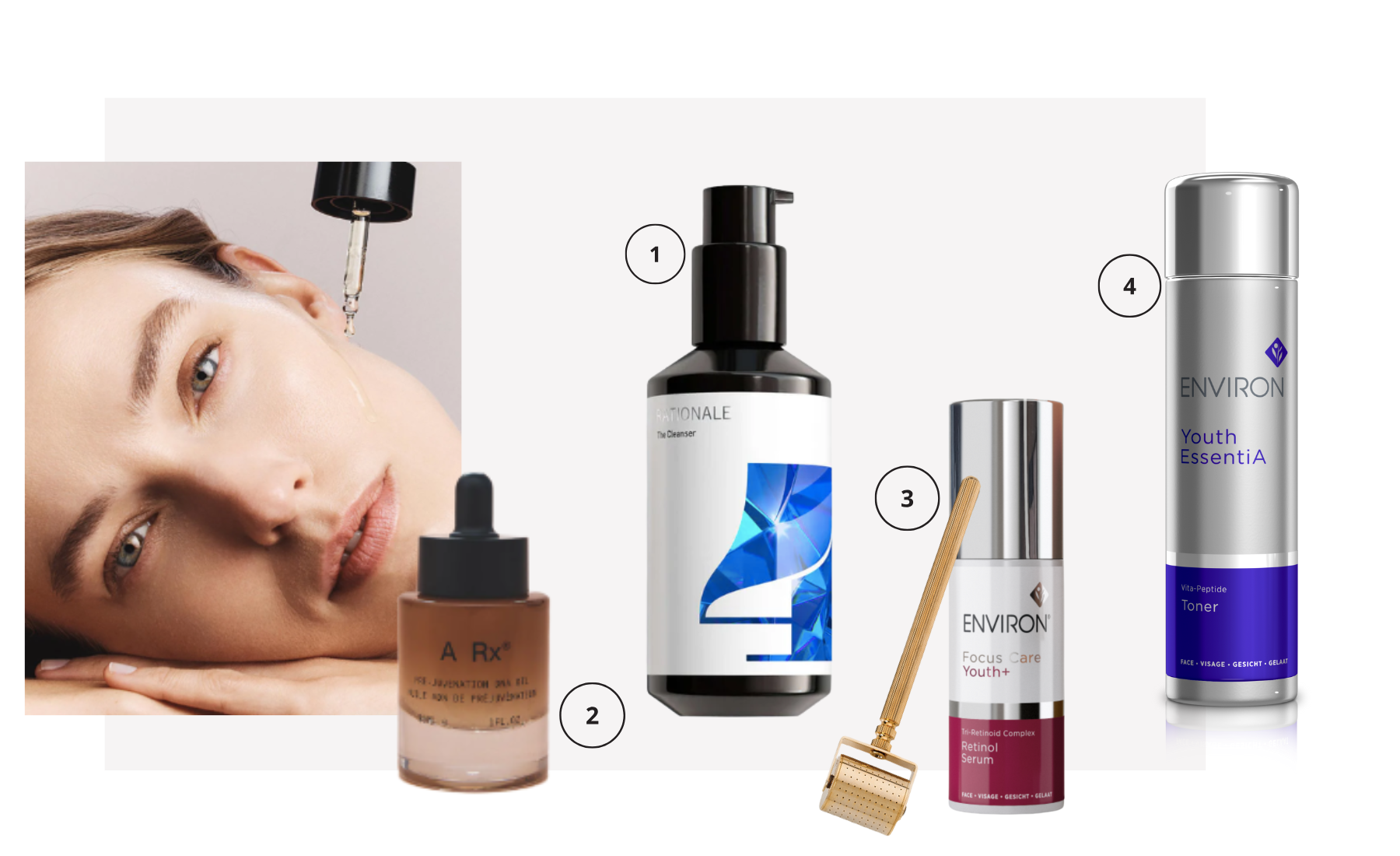
1. Rationale – The Cleanser. 2. Aesthetics Rx – Pre-Juvenation DNA Oil. 3. Environ – Gold Roller + Retinol Serum. 4. Environ. Moisturising Vita Peptide Toner.
Myth #4: Natural products are always best
“Natural,” “clean,” “green,” “non-toxic” — all nice-sounding words, all largely unregulated. What one brand calls natural might be plant-based, organic, cruelty-free, preservative-free… or none of the above.
Here’s what matters: performance, safety, and proof. Some of the most irritating ingredients I’ve seen on skin are “all-natural” plant extracts. Nature can be wonderful, but it can also be harsh, allergenic, and unpredictable.
This is where biotech skincare comes in — and why it’s becoming the way forward. Instead of harvesting ingredients from the environment, biotech allows us to create them in a lab, bio-identical to what’s found in nature but without the same environmental cost.
Think of lab-grown hyaluronic acid, fermented antioxidants, or peptides designed to trigger the skin’s own repair processes. They’re consistent in quality, often purer than their natural counterparts, and can be produced without stripping ecosystems of plants or overfishing marine sources.
For your skin, biotech ingredients offer potency, stability, and precision — they can be formulated to deliver results without the unpredictability of raw extracts. For the planet, they mean less land cleared for agriculture, less water use, and a lower overall carbon footprint.
For me, the question is not “Is it natural?”, but is it “Is it effective, safe, and responsibly made?” That’s the real beauty of the future.
Myth #5: Collagen and elastin creams erase wrinkles
This one has been going around for decades. Collagen and elastin are too large to penetrate your skin from the outside — it’s physically impossible to “replace” lost fibres by rubbing them on.
These creams can temporarily hydrate and plump (especially if they contain hyaluronic acid), making skin look smoother for a few hours.
But to truly stimulate collagen production, you’d be looking at formulations with retinoids, peptides, and specific in-clinic treatments, or — in the ingestible category — collagen supplements with growing evidence to support them.
If a jar claims to “restore” collagen directly, it’s marketing, not magic.
For me, I’m reaching for gentle retinol, used consistently, to improve wrinkles caused by environmental damage.
Myth #6: Hypoallergenic means it won’t cause a reaction
“Hypoallergenic” sounds reassuring, but it’s not a guarantee of anything. There’s no universal standard for the claim — some brands base it on a small patch-test group, others just use the term because they’ve left out a common irritant.
Similarly, “for sensitive skin” and “dermatologist tested” are more marketing language than scientific proof.
Skin sensitivity is more common than ever — thanks in part to over-exfoliation, strong actives, and barrier damage. If your skin reacts often, don’t rely on the label. Sample first, read the ingredient list, and, if issues persist, get patch testing by a dermatologist to identify your allergen triggers.
Bonus tip: If it tingles, it’s working
I used to think that the tingling was proof a product was doing its job — and there’s no getting away from the fact that some ingredients, like AHAs, BHAs, or certain vitamin C formulas, can cause a mild, temporary tingle.
But tingling isn’t required for a product to be effective. In fact, that sensation often signals irritation rather than results. If the tingle quickly subsides and your skin looks calm, you’re probably fine. But if it lingers, turns into stinging, or leaves your skin red and tight, it’s a sign you’ve pushed your skin too far. The best products often work quietly, delivering results without making a scene.
I’ll be covering this in much greater detail — including how to tell the difference between a healthy tingle and barrier damage — in the next chapter of my e-book The Retinoid Lab.
The bottom line
In a world where algorithms and clever marketing amplify trends, news travels faster than fact-checking, and beauty myths can live on indefinitely.
The best defence? Ask “why” before you buy. Look for proof, not promises. And remember — hype is rarely a sign of substance.
Have a beauty myth you’ve always wondered about? Drop me an email — I read and respond to every one.
