
Originally published 19 October 2022. Updated October 2026 to reflect current menopause guidance and developments in Australian care.
Every year in October, Menopause Awareness Month highlights the needs of women, encourages better medical care, helps dispel myths and misinformation, and challenges the stigma associated with menopause. World Menopause Day falls on 18 October.
If you’ve already reached menopause or you’re going through it, you’re probably well acquainted with the numerous symptoms that can beset you, unless you’re one of those lucky women who breeze through it. Go you!
So, how do you know when you’ve reached menopause?
Perimenopause is the stage leading up to menopause, when reproductive hormones fluctuate and symptoms can begin. It often starts in your 40s, although the timing varies. You’ve officially reached natural menopause when you haven’t had a period for 12 months, provided there isn’t another cause. If you’ve had a hysterectomy or use hormonal contraception, that milestone can be harder to identify.
So why do we need a month-long menopause awareness campaign?
If you’re yet to reach menopause, you might wonder why we need an entire month to talk about it.
Let’s start with a simple truth.
Menopause can be a lonely place, affecting every aspect of your life.
It can hurt relationships as you struggle with mood changes, anxiety or feelings of depression and rage.
Coping at work can become difficult. Opening up to your employer, hoping they’ll understand rather than perceive you as weak or less capable, can feel daunting.
Your self-esteem can take a hit, and self-compassion goes out the window as you berate yourself after another emotional rollercoaster.
Not every woman experiences this, but those who do deserve understanding and support.
We, the women of the world unite!
With so much disruption to daily life, surely we deserve the medical world to be fully on board and support us at this significant time of life.
Greater awareness among medical professionals, better access to reliable information and informed conversations about treatment should be things we can take for granted.
Seriously. We should expect nothing less.
Our doctor should help us understand what might be happening, consider other possible causes of our symptoms, and explain the medical and practical support available.
But, of course, you might ask, surely my doctor can help, and I won’t be fobbed off again? Well, as I’ve been told by a doctor, menopause is not an illness. It’s not really what you want to hear as your hair begins to fall out, your libido disappears, anxiety and depression pay you a visit, and sleep becomes elusive.
Here in Australia, there has been progress since I first wrote this article in 2022. Medicare-funded menopause and perimenopause health assessments began in July 2025, more hormone therapy options have been added to the Pharmaceutical Benefits Scheme, and a national menopause awareness campaign launched in May 2026.
These changes deserve recognition. If you’re seeking help, ask your GP about a menopause health assessment and what it could cover.
And if you’re feeling the need to get even rather than simmer with rage, you can still lobby your local member of parliament for better services and support. Progress gives us something to build on.
But how did we get here? Why has getting good advice about menopause been such a struggle?
The 2024 Australian Senate inquiry highlighted gaps in medical training on menopause and perimenopause. And then there’s the lasting influence of the headlines that followed one major study.
It’s been a cold war since 2002
In 2002, the combined hormone therapy arm of the Women’s Health Initiative trial was stopped early after researchers found that the overall risks outweighed the benefits for the women and treatment studied. The findings included increased risks of breast cancer, blood clots, stroke and heart disease, and prescribing fell sharply afterwards.
But why? What happened?
The study tested a particular combination of oral oestrogen and progestogen, mainly to investigate whether hormone therapy could prevent chronic disease. The women were, on average, 63. It wasn’t designed to answer the everyday question of whether a woman entering menopause should use hormone therapy to relieve her symptoms.
There were flaws in how the findings were reported and interpreted. Results from that particular treatment and study population were applied too broadly, leaving many women and doctors with the impression that hormone therapy was dangerous across the board. That criticism concerns how the results were communicated and used; it doesn’t mean the study found no real risks.
Subsequent analysis has helped clarify the importance of age, time since menopause and individual health risks. For appropriately selected women, hormone therapy can offer substantial relief from troublesome symptoms. It isn’t recommended simply to prevent heart disease or other chronic diseases.
Unfortunately, the fear surrounding hormone replacement therapy after 2002 left its mark.
Twenty-four years on. What now?
So, here we are 24 years later, with a better understanding of hormone therapy and more support available.
If you’re curious about treatment and your doctor advises against it, ask them to explain why. There may be a sound medical reason. But if you feel dismissed or your questions remain unanswered, getting a second opinion is reasonable.
That’s the kind of conversation I wish I’d been able to have when I first sought help.
I reached menopause at 50ish and suffered my fair share of symptoms in the years that followed, some of which I’ve written about, including hair loss and how menopause changes your skin.
When I was looking for medical support in 2010, the doctors I consulted were reluctant to prescribe hormone replacement therapy.
By then, researchers had already begun to clarify how age and time since menopause affected the findings. But that more nuanced understanding was missing from the advice I received.
Too many risks, they said; the science was against it, they muttered.
For women like me, getting beyond that reluctance could feel like begging. And even when a prescription appeared, the explanation didn’t necessarily follow.
I remember not-so-fondly the young doctor who tentatively pushed the script towards me without any discussion.
“Oh, you want an HRT to help with insomnia? Errrr… Okay.”
This barely audible mumble hardly gave me the confidence to take the damn medication.
So many questions. So few answers.
What was I taking? Horse urine? What should I expect? How would hormone replacement therapy help me? Should I take it, Doc? What do you think? Will I get cancer? What about heart disease and stroke? Will it help with my chronic insomnia?
Nope. Nothing. Ushered out into the great unknown, into the comforting arms of Dr Google.
So, naturally, the script was filled, but not one pill was taken. Sounding familiar?
And your doctor’s irritated when you mention Dr Google? Really?
What can hormone replacement do for you?
Hormone replacement therapy, or HRT, is now often called menopausal hormone therapy, or MHT. You’ll see both terms used.
MHT is the most effective treatment for hot flushes and night sweats. It can also help prevent bone loss and fractures, and may help with sleep difficulties and some menopause-related mood symptoms.
Treatment can include oestrogen in a patch, gel or tablet. If you still have a uterus, you’ll generally also need a progestogen to protect its lining. If you’ve had a hysterectomy, oestrogen alone is often appropriate. The formulation and schedule should suit your circumstances.
Signs and symptoms of perimenopause, menopause and postmenopause
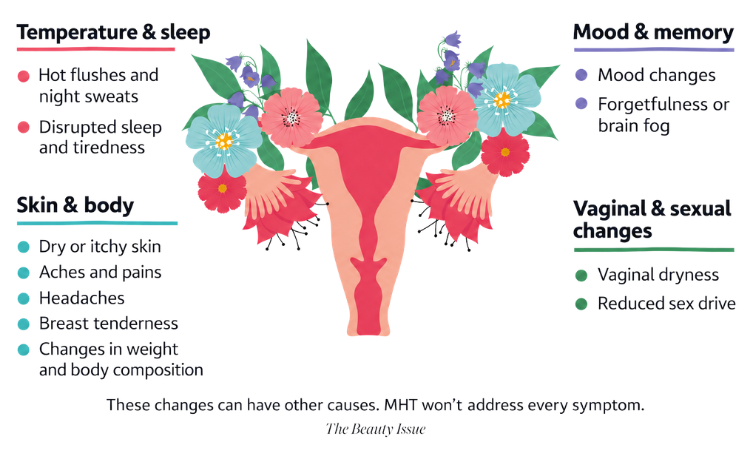
Not everything on that list is necessarily caused by menopause, and MHT won’t address every symptom. Your doctor should consider the whole picture.
Let’s look a little closer at some of the more troubling symptoms and health changes around menopause, and where hormone therapy or other support may help.
Mood swings and depression?
I’ve always said menopause is liberating, and in many ways, it is. Not getting a period every month is bloody brilliant, pardon the pun, and for me, being free of the mood swings that came with my cycle was also blooming marvellous.
During perimenopause, however, mood changes, anxiety and depression can be debilitating.
Hormonal fluctuations may contribute, but a proper assessment should also consider your mental health history, sleep and what else is happening in your life. Treatment may involve psychological support, antidepressants, MHT or a combination. Antidepressants aren’t automatically the wrong treatment simply because you’re going through menopause.
What we need is someone willing to look at the whole picture.
Muscle and bone loss
The loss of oestrogen accelerates bone loss around menopause. If bone loss progresses to osteoporosis, the bones become more fragile and fractures more likely. Finding ways to reduce that risk deserves our attention.
What about your muscles? Surely you jest? They were the first thing to go!
Muscle mass and strength also change as we age, with menopause contributing to the picture. Regular resistance training can help maintain or build strength and support bone health. Weight-bearing activity and balance exercises also have a useful role.
Alongside exercise, adequate protein and appropriate calcium and vitamin D intake matter. If you’re concerned about bone loss, ask your doctor about your risk and whether you need a bone density scan or treatment.
If working out is new to you, start gradually. A physiotherapist or appropriately qualified exercise professional can help, particularly if you have osteoporosis or pelvic floor symptoms. Perhaps buddying up with a friend is a nice idea and keeps you motivated.
Sexual dysfunction, urinary incontinence and vaginal irritation
Libido? What libido? You’re kidding, right?
If a change in sexual desire is bothering you, or sex has become uncomfortable, there are options worth discussing.
Local vaginal oestrogen can help with dryness, irritation and painful sex, and some urinary symptoms. It can be used on its own or alongside systemic MHT. Improving comfort doesn’t necessarily restore libido, though. Sexual desire can be affected by several things, and may need a separate assessment.
And no woman should have to put up with urinary incontinence without medical advice and support. Pelvic floor physiotherapy and other treatments may help, depending on the cause.
Discuss your specific needs and desires, or lack thereof, with your doctor. I know this may all feel a little uncomfortable, but there are solutions worth exploring. And if your doctor isn’t listening, find a doctor who will.
What does oestrogen do for your skin?
Let’s get to what it can do for the health of your skin. Despite all my efforts to keep lines, wrinkles, blotchy pigmentation and sun damage at bay, by the time I reached 60, the changes in my skin were becoming harder to ignore.
Collagen is one of the proteins that gives skin its strength and support. The decline in oestrogen around menopause contributes to changes in collagen, skin thickness and elasticity. Those changes can begin well before 60, alongside the effects of sun exposure and ageing.
So, where had my collagen gone? Well, menopause was part of the picture, even if it wasn’t the whole story.
Of course, skincare can help support skin health and improve some visible signs of ageing. I wouldn’t suggest going on hormone replacement just for the sake of the collagen in your skin, though. That decision belongs in a medical conversation about your symptoms, health and individual risks.
What about breast cancer?
It’s understandable to have questions about breast cancer. They deserve a proper answer.
In Australia, around one in seven women will develop breast cancer in their lifetime, although that lifetime figure doesn’t tell you your risk over the next few years. Your age and personal history matter.
Combined systemic MHT can increase breast cancer risk, and the increase is greater with longer use. Oestrogen-only treatment has a different risk profile, so all hormone treatments shouldn’t be treated as interchangeable.
Ask your doctor what the proposed treatment means for your own risk, ideally in actual numbers over a stated period of time. Then you can weigh that information alongside the benefits you’re hoping for.
Your doctor can also advise on appropriate health checks and screening. BreastScreen Australia routinely invites women aged 50–74 for a mammogram every two years, although individual risk may call for a different schedule.
Other factors, including family history and alcohol consumption, also matter.
Alcohol increases breast cancer risk, and drinking less can reduce that risk. But it doesn’t make concerns about MHT irrelevant; both deserve consideration.
Alcohol consumption is one of the major modifiable risk factors for the disease, causing 7 of every 100 new breast cancer cases in the region.
If you haven’t done so already, it might be time to think about your relationship with alcohol.
How long can you take it?
There’s no single time limit that suits everyone. Some women use MHT for a few years; others continue longer, with regular review of their symptoms, medical history and changing risks.
Of course, you must discuss this with a trusted medical doctor, as what’s right for one woman may not be suitable for another.
Should you stop at 60?
Initially, my doctor told me she would not prescribe after 60; that was when I was 58. When I returned at 62, expressing concerns about my bone health after a bone scan, she did not hesitate to write me another prescription.
So, it’s a matter of weighing up the benefits and risks for the individual woman.
There isn’t an automatic stopping age of 60 or 65. However, starting systemic MHT after 60, or more than ten years after menopause, generally has a less favourable benefit–risk balance than starting earlier. Continuing established treatment is a different decision, and both require individual assessment and regular review.
Your heart health, risk of blood clots, breast cancer history and other medical factors all belong in that conversation.
If you’d like to read more about menopause, I recommend Dr Ginni Mansberg’s book, The M Word: How to Thrive in Menopause.
My final thoughts?
Seriously, can I say it any louder? If you’re struggling with symptoms of menopause, consider visiting your doctor and discussing what could help, including hormone therapy.
Of course, a disclaimer. I’m not a doctor, but I am a post-menopausal woman, and I’ve spent a lot of time thinking about and researching menopause.
Systemic MHT may not be suitable if you have a history of breast cancer, blood clots, certain heart conditions or other medical concerns. Even so, there are non-hormonal treatments and other forms of support to discuss.
Talk to a well-versed medical doctor who knows what’s what. Then you can decide whether hormone therapy is suitable for you, or whether other options would better meet your needs.
If you found this article informative or helpful, please share it with the other women in your life.
See you next time,

Frequently asked questions about menopause and hormone therapy
What’s the difference between HRT and MHT?
HRT stands for hormone replacement therapy. MHT stands for menopausal hormone therapy, the term now commonly used for hormone treatment associated with menopause. You’ll see both terms used.
Does hormone therapy increase breast cancer risk?
Combined systemic MHT can increase breast cancer risk, particularly with longer use. Oestrogen-only treatment has a different risk profile. Your doctor can explain how the proposed treatment may affect your individual risk and help you weigh that against its potential benefits.
Do you have to stop MHT at 60?
There’s no automatic stopping age of 60 or 65. Continuing established treatment is different from starting it later. Starting systemic MHT after 60, or more than ten years after menopause, generally requires greater caution. Both decisions should involve individual assessment and regular review.
What if you can’t take MHT or don’t want to?
Other options include non-hormonal prescription medicines and psychological therapies that can help with particular symptoms. Local vaginal treatments may also be appropriate for vaginal discomfort. Your doctor can help identify suitable options based on your symptoms and medical history.
Medical disclaimer
This article provides general information and education, drawing on published research and my personal experience. I’m not a medical practitioner. The content does not replace individual medical advice, diagnosis or treatment. Decisions about menopausal hormone therapy or other treatments should be made in consultation with your doctor, taking into account your symptoms, medical history and individual benefits and risks. Do not start, change or stop prescribed treatment, or delay seeking medical care, based solely on information in this article.