
This article is about exfoliants that scrub the skin, and why you should consider your approach to exfoliation. But, before I get to why I constantly crusade against facial scrubs, a story from my youth.
When I was 17, I read somewhere, some little tidbit of advice, that I could smooth away wrinkles by 1) heating the back of a dessert spoon and then 2) proceeding to smooth over any offending wrinkles with said spoon. Voilà! Wrinkles Gone!
Clearly, I started raising my eyebrows at life and all its conundrums at quite a young age, hence wrinkles at 17. Even so, I was determined to banish these weird lines that had taken up residence on my forehead.
Okay, laugh away! Compared to the onslaught of skincare marketing to children these days, the idea of me ironing away my fledgling wrinkles seemed perfectly normal, if not absurd. But, in my defence, I was only 17, and Cosmopolitan Magazine was my go-to when it came to beauty advice. But was it really sage advice? Ummmmm, maybe not so much.
In hindsight, of course, this idea was completely BONKERS!!
The advice just kept coming.
The other skin tip that I went at with great abandon was to scrub my skin; the promise of clean, perfect, pimple-free skin was all I needed to hear.
Again. What the hell? Oh, hang on, we all did it, some of us still do. Suddenly, I don’t feel so bad. But, I do feel bad, what seemed okay at 17 now, as a fully grown-up skin therapist, is the kind of advice I find quite disturbing.
If I hear of someone scrubbing their skin to clean it, eliminate blackheads, or get rid of dead skin cells to combat emerging wrinkles, I feel nothing but dismay.
In fact, I feel so bad about it that I’m dedicating this entire post to convincing you and your loved ones to give up the scrub. FOREVER!
Okay, so just to be clear, I’m referring to facial scrubs, and I shall go out on a limb and include facial brushes in my crusade. The skin on the rest of your body can handle a little gentle physical exfoliation (if you must).
Let’s clear out your bathroom cabinet.
The abrasive scrub must go, but first, just in case you think I’m kidding, and your belief is strong. I’m going to tackle a three common myths taking up space in your bathroom cabinet.
Myth #1: Facial scrubs clean your skin and prevent clogged pores.
It’s true; if you have particularly oily skin, then you’ll probably develop clogged pores. This happens when the amount of oil produced by your sebaceous glands is excessive, and the flow of oil to the surface of your skin becomes sluggish, trapping dead cells and clogging the openings of your pores. What you end up with are lumps, bumps and blackheads.
Of course, you don’t want that. Right?
But here’s the thing. Every time you strip the natural oils and lipids from your skin with continuous scrub use, your skin pumps more oil to the surface while becoming increasingly dehydrated from all the scrubbing.
So now, imagine this.
The opening of your follicles begins to fill with dehydrated skin cells, which become trapped. Oil flow becomes restricted, leading to a buildup at the opening of your pore.
Bam! You’ve got yourself more of the problem you were trying to fix. Lumps, bumps and probably blackheads. Of course, all this can occur without your encouragement, and there are ways to prevent it. But why make things worse? Scrubbing will exacerbate the problem. Scrubs are not the solution.
Myth #2: Facial scrubs leave the skin feeling fresh, radiant and glowing.
Sure, for about 30 minutes.
After you’ve scrubbed your skin, you’ll feel tingly and all a-glow. But really? You’ve just stripped your skin, and tomorrow it’ll look dull and lifeless once again.
In your frustration, you’ll do it all again, to get the same tingly fresh feeling and on and on it goes.
What’s happening?
Imagine your skin barrier like a seashell eroded by waves; your skin’s protective barrier weakens over time from scrubbing. This isn’t a glow, it’s damage.
So, now imagine your acid mantle: every day, the delicate lipids and the very structure of your skin, protecting you from the outside world, are being eroded by your scrub.
What you thought was helping is setting you up for a whole new set of problems, such as redness, irritation, and weak, lifeless skin that has lost its ability to function properly and protect you from bacterial invaders.
Not only that, but oily skin will become oilier, more clogged, and definitely out of balance.
There’ll be no glow here. Nope. Sorry.
Myth #3: Facial scrubs remove dead cells to encourage cell renewal.
It’s certainly true that to keep your skin well hydrated and radiant, and keep your skin cells turning over, exfoliation is essential.
It’s just not going to be achieved with facial scrubs. Not now. Not ever!
Sure, you may remove some of the dead cells, but to hope you’ll achieve radiance and luminosity? I’m afraid it’s just not so.
As I’ve already mentioned, you’ll strip the skin, creating dehydration and, even worse, your scrub has haphazardly removed skin cells. Haphazard is not what you should be aiming for.
But it gets worse.
You’ll create micro-tears in your skin. Not the result you want. Do you?
What to do, I hear you say?
Okay, well, first. Go check your bathroom cabinet and remove anything that looks like a facial scrub or brush, unless you want to keep it for your body.
Ditch the scrubs: A bold move toward healthier skin
So what now? What replaces your abrasive scrub or high-tech cleansing brush?
Well, the best way to exfoliate your skin is to look for a liquid serum with exfoliating ingredients such as lactic, glycolic, or salicylic acid. When applied to your skin, these serums and creams will naturally loosen the dead cells that accumulate in your follicles. Your pores will begin to unblock, and the turnover of skin cells will be regulated.
I like to call these formulations liquid or cream exfoliants.
Start with a mild solution and introduce it gradually into your beauty regimen; maybe once or twice a week until it feels comfortable to apply every night. Eventually, your skin will become accustomed to these dead-skin-cell-busting ingredients.
 How AHA and BHA acids safely exfoliate your skin
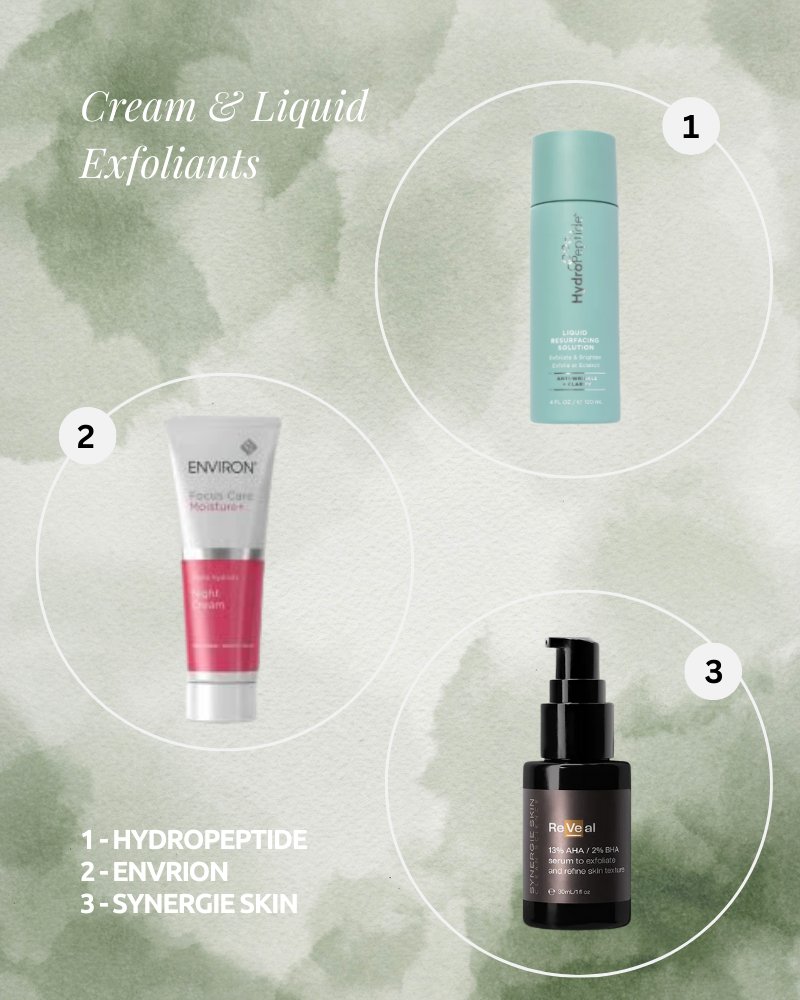
They’re by no means new; the first use of lactic, glycolic and salicylic acids dates back to the ’50s, gaining momentum in the last 20 years, with many cosmeceutical brands creating take-home serum and cream formulations.
Alpha Hydroxy Acids (AHA) and Beta Hydroxy Acids (BHA) are two key ingredients that effectively exfoliate the skin.
What to look for?
Alpha Hydroxy Acids.
AHAs are derived from sour milk, sugar cane, apples or grapes, bitter almonds, as well as the herb Centella Asiatica.
BHA, on the other hand, only comes from one source, and that’s salicylic acid, derived from White Willow Bark.
Both AHA and BHA exfoliate the skin, but in slightly different ways.
AHAs are ideal for all skin types, especially dry skin types.
My personal favourite is the AHA known as Lactic Acid. Not only does it remove the dead skin cells from the surface of your skin, but it’s an essential ingredient in stimulating the skin’s Natural Moisturising Factor. How cool is that! You’ll be exfoliating and hydrating simultaneously.
Beta Hydroxy Acid
BHAs are most useful for oily, acne-prone, problematic skin, offering a triple-action exfoliation, bacteria control, and inflammation reduction.
Look for serums specifically designed to exfoliate; ideally, your AHA serum should contain 5-10% to be effective, and BHAs should include no more than 2% in your formulation. A sprinkling of these ingredients in your daily moisturiser or BB Cream, although nice, will not be the best approach if you want amazing results.
Why skincare brands still produce facial scrubs?
Great question. The short answer? Because you want them. Doesn’t mean they’re good for you. They’re not.
And a little disclaimer, even some of the brands that I recommend on this site have exfoliating scrubs in their range, which is frustrating, and I know it seems a bit of a contradiction.
All I can say is, take the good, throw out the not-so-much, and if your favourite brand has a scrub within the range, just skip it. Your money is much better spent on products that do good. That’s all.
Breaking the habit of using scrubs for healthier skin
I know for some of you this may be a hard habit to break, but I’ve always promised you the truth in how to care for your skin, so, although a little controversial, taking scrubs out of the bathroom cabinet forever will, I promise, give you much better skin.
And on a personal note, you may feel the same way. How does it do for the planet? Many abrasive scrub granules are made from plastic. Not good. The good news is that many countries around the world are now banning them from cosmetic products. So, if you care about our beautiful planet, then you may also like to read why the microbead has been banned in my article: The Microbead Myth.
If this post has provoked a bit of thought or challenged your long-held beauty beliefs, and you need to know more, shoot me an email.
See you next time.
