
Retinyl palmitate is a form of vitamin A that offers daily protection for your skin. Think of it as your skin’s best friend – always there, always supportive – and yes, it’s found naturally in your skin.
Your body needs vitamin A for a range of important functions, but today, I’d like to focus on its role in skin health – and specifically, on retinyl palmitate, which is often misunderstood but plays a vital role in keeping skin healthy and resilient.
It gets there via the bloodstream – released from the liver as retinol, then converted in the skin to retinyl palmitate, where it’s stored until your skin calls on it for renewal, repair and day-to-day function.
This essential nutrient supports skin renewal, reinforces the barrier, aids in repair, and offers antioxidant protection against sun exposure – helping defend against free radical damage and, in turn, protecting the DNA inside your cells (the blueprint, if you will) that governs how your skin functions and heals.
But here’s the catch – your skin’s supply of vitamin A isn’t endless. Every day, it’s degraded by sunlight, pollution and environmental stress. UV exposure, in particular, breaks down the natural stores of retinyl palmitate in your skin, leaving it more vulnerable to damage.
The more your skin is exposed to these elements, the more it draws on those internal reserves to defend itself. Over time, that demand outpaces what your body can naturally replace on its own.
Without consistent replenishment, your skin becomes depleted and less able to protect and repair itself. If you add excessive sun exposure without consistent broad-spectrum sun protection into the mix, it eventually leads to long-term damage to your skin’s DNA – the internal blueprint that governs how your skin cells grow, renew, and repair. When that blueprint is compromised, everything slows down: turnover, healing, resilience, and signs of ageing become more apparent.
The good news? Daily use of broad-spectrum sunscreen protects your skin from further harm, while a topically replenishing vitamin A, especially in the form of retinyl palmitate, helps restore what’s been lost.
By applying a daily dose of a gentle retinyl ester, such as retinyl palmitate, you’re helping your skin defend itself, maintain its integrity, and repair the early visible signs of sun damage before they become long-term issues.
Enter Retinyl Palmitate
Retinyl palmitate is an ester of vitamin A – and it’s the main storage form of vitamin A found in the epidermis, the top layer of your skin.
While it doesn’t replace the need for daily broad-spectrum sunscreen, it does offer antioxidant support that helps protect the skin from the oxidative stress caused by sunlight and environmental exposure.
Retinyl palmitate helps neutralise free radicals and, as a gentle form of vitamin A, it’s well-tolerated by most skin types. That makes it ideal for maintaining your skin’s vitamin A levels without irritation.
When’s the best time to apply? Morning or night?
You may have heard you shouldn’t apply vitamin A during the day, and that’s partly true. Some forms, like retinol, can be unstable in sunlight. But a low concentration of retinyl palmitate? Absolutely! It belongs in your morning routine as it helps top up what your skin might lose throughout the day.
There’s no point going to all this effort if you’re skipping SPF. Think of retinyl palmitate and sunscreen as a double act – one supports your skin from within, the other shields it from the outside. Rain, hail or shine.
How to avoid a vitamin A deficiency within your skin?
It’s worth noting that after sun exposure, it can take many days for the body to restore vitamin A in the skin, making daily topical application necessary to maintain the skin in a healthy and normal state.
- Apply a topical vitamin A, such as retinyl palmitate.
- For the overall health of your skin, and to prevent many of the skin conditions we’ve talked about today.
- If you’re applying retinyl palmitate every day, both in the morning and at night, rest assured that your skin always has what it needs to protect itself.
- Wear broad-spectrum sunscreen every day.
- While vitamin A is destroyed by daily exposure, a broad-spectrum sunscreen will limit damage to the DNA of your cells.
- Vitamin A is stored in the liver as retinol and, when needed, is released into the bloodstream.
- Choose a balanced diet with foods rich in Vitamin A.
- Animal protein and dairy products are good sources of vitamin A.
Playing and winning the long game.
Retinyl palmitate has fewer side effects than other forms of vitamin A, such as retinoic acid or retinol. When used daily, retinyl palmitate provides your skin with long-term protection and a better chance of combating sun-induced skin damage.
And, as retinyl palmitate is less irritating than its stronger siblings, there is a greater chance you’ll continue with the application of vitamin A. In contrast, retinoic acid or pure retinol can cause troubling redness and irritation, increasing the likelihood that you will stop altogether.
But you’ve heard retinol is your best option?
Retinol is often recommended to minimise the visible signs of ageing, and for good reason. It converts more readily into retinoic acid (the active form of vitamin A), and it plays a powerful role in DNA repair and stimulates collagen, elastin and hyaluronic acid production in the skin’s extracellular matrix.
But here’s the thing: if your skin is already sun-damaged, it might not respond to retinol the way you expect. Sun damage can impair the enzymes and receptors your skin needs to process and use retinol effectively. So even though retinol makes it into the cell, it may not be converted efficiently or deliver results.
That’s where retinyl palmitate comes in. As a gentle, well-tolerated vitamin A ester, it can be used daily to maintain healthy skin function and ‘prime’ the skin, restoring its natural vitamin A pathways over time. Then, when the time is right and your skin can handle more, stepping up to a retinol serum makes much more sense.
The Retinoid Pathway.

Persuading damaged skin cells to accept vitamin A.
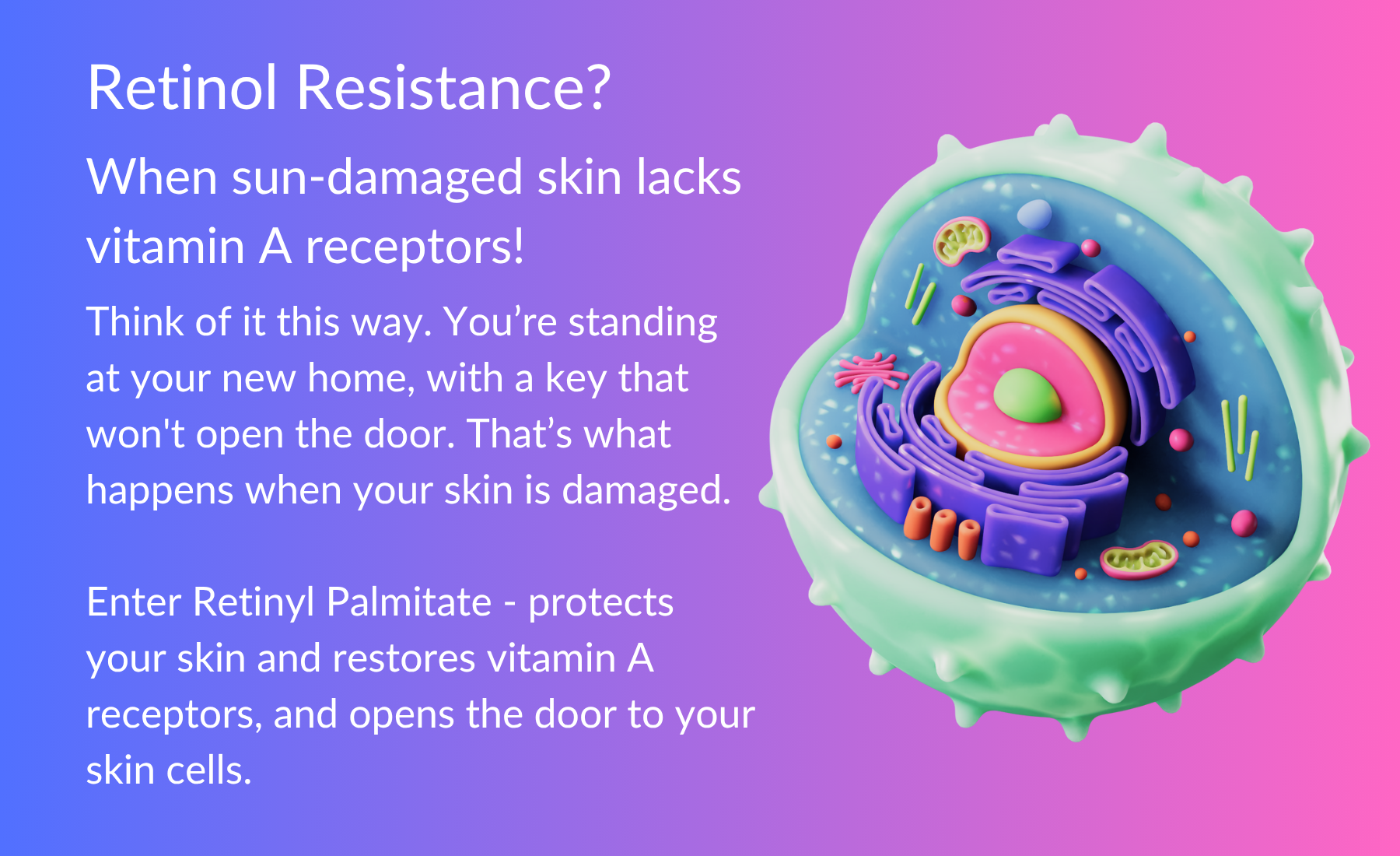
Think of it this way: you’ve got the key to your new home, but you’re still sitting on the stoop, unable to get inside because the lock’s broken. No amount of jiggling that key is going to get you through the door.
That’s a bit like what happens in sun-damaged skin. Over time, chronic UV exposure can reduce the number of vitamin A receptors in the cell and disrupt the enzymes that help convert retinol into its active form. So even if you’re using a potent product like retinol, your skin might not be ready to use it properly – and what doesn’t get used, can irritate. Retinoid dermatitis, anyone?!
That’s where vitamin A esters come in. A gentle, consistent supply of retinyl palmitate can help wake up those sluggish receptors and slowly restore the skin’s ability to respond. You’re not forcing the door open – you’re fixing the lock.
If you’re in this for the long haul – and you should be – a retinyl ester is the ideal way to build tolerance and support your skin long before stronger retinoids enter the picture.
The Two-Fold Function of Retinyl Palmitate
Firstly, as we’ve already touched on, retinyl palmitate helps protect your skin from environmental stressors. This makes it a key player in maintaining skin that’s not only healthy but also resilient.
Secondly, once stored in the skin, retinyl palmitate can be converted into retinoic acid – the active form of vitamin A. From there, it’s picked up by vitamin A receptors and delivered into the cell, where it travels to the nucleus to support DNA repair and regulate how the cell behaves.
Vitamin A receptors are like the front door of your home – you hear a knock, and if you recognise the visitor, you let them in. If the receptors aren’t working properly, no one gets through the door.
Pretty cool, right?
For me, the key message is this: don’t wait until problems show up. An ester of vitamin A is gentle enough to use daily, regardless of your age. The sooner you start, the healthier your skin.
But we’re not done yet. Beyond the day-to-day support a retinyl ester provides, what about your skin’s deeper structure? What role does vitamin A play in protecting collagen, elastin, and hyaluronic acid – the building blocks of your skin matrix?
Vitamin A and Collagen: Deep in the Dermis
Let’s go a little deeper – into the dermis, where the real structural work happens.
This is where you’ll find fibroblasts, the specialised skin cells responsible for making collagen – the protein that keeps your skin firm, plump and supported. But while your fibroblasts are busy building, another set of enzymes (called collagenases) is breaking things down.
Sure, it’s just biology – a constant cycle of renewal and breakdown. But when breakdown starts to outpace repair, we see thinning, sagging, and loss of elasticity. Ouch! You don’t want that! Me neither.
The good news? Vitamin A helps tip the balance back in your favour. It stimulates fibroblasts to produce more collagen and inhibits the activity of collagen-degrading enzymes, helping to preserve your skin’s structure and strength, and this is where concentrated retinol or retinaldehyde serums come into their own.
Vitamin A stimulates new collagen and protects existing collagen. This is a win on all counts. You’ve won the skincare lottery with your daily supply of vitamin A.
If you’d like to dive a little deeper into how this works, you might like this article:
Vitamin A for the Skin: Activate Your Youthful Enzymes.
The Esters of Vitamin A for Your Skin
Think of vitamin A esters as siblings – they each have their own strengths, work well together, and all follow the same path: they need to be converted into retinoic acid (the active form) via the retinoid pathway.
Here’s a quick breakdown:
Retinyl Palmitate
Found naturally in the epidermis, this is a combination of retinol and palmitic acid. It’s the most abundant form of vitamin A stored in the skin – gentle, stable, and essential for supporting everyday skin health.
Retinyl Propionate
Another retinol ester, paired with propionic acid. It has better bioavailability than retinyl palmitate and is still very well tolerated. A solid choice if you’re after something a little more active without tipping into irritation.
Retinyl Acetate
This one’s a smaller molecule, combining retinol with acetic acid. It’s slightly more potent than the other esters and plays well in formulations where you want a bit more activity, like the confident sibling who gives the others a nudge forward.
Hydroxypinacolone Retinoate (HPR)
Technically an ester – but a bit of a wildcard. It doesn’t require as many conversions to become active and is often paired with absorption enhancers. It’s marketed as a non-irritating alternative, but research is still catching up. Promising? Maybe. Proven? Not quite yet. I’ll keep you posted.
Vitamin A alcohols, acids and aldehydes.
Retinol
This is the alcohol form of vitamin A. It’s well known and widely available — and while it’s effective, it can be irritating, especially if you dive in too quickly or your skin doesn’t have the receptor strength to handle it yet.
Best approach? Keep it in your toolkit. Use it a few nights a week for a more active result, but don’t ditch your daily dose of a gentler retinyl ester. The ester builds resilience — the retinol brings the punch.
Tretinoin
Also known as retinoic acid, this is the active (carboxylic acid) form of vitamin A. In Australia, it’s only available by prescription. Your skin knows exactly what to do with it — it doesn’t need to be converted — but that also means it can be intense. For some, the benefits outweigh the potential irritation; for others, it’s a bit too much.
*Important note: Retinoic acid should not be used during pregnancy, as it may cause birth defects.
Retinaldehyde
This is the aldehyde form of vitamin A — a step away from retinoic acid in the conversion pathway. It’s powerful, well-tolerated, and doesn’t require as much enzymatic processing as retinol. But it comes with trade-offs: it’s expensive, and some argue it’s not stable enough in all formulations to do the job reliably.
Bottom line?
All forms of vitamin A work in the skin, but they differ in intensity, speed, tolerance, and comfort.
Retinyl palmitate is already present in your skin, making it a smart place to start your vitamin A journey. It’s there to support daily function and defend your skin, not just from UV exposure, but also from airborne pollutants and free radicals that accelerate damage.
That’s why topping up daily with a retinyl ester, such as retinyl palmitate, makes so much sense. It helps prevent long-term damage, slows premature ageing, reduces collagen breakdown, and strengthens your skin barrier against moisture loss and environmental stressors.
And now you.
Phew — that was a long read. Hopefully, you now have a clearer, more confident understanding of vitamin A for the skin, especially the often-overlooked ester, retinyl palmitate.
It may not be high tech, it may not trend on TikTok. But in terms of daily defence, long-term skin health, and gentle effectiveness, it deserves a lot more credit than it gets.
You might also like this interview with Dr Des Fernandes, the founder of Environ and a pioneer in using vitamin A in skincare and Beauty Editor Nadine Baggott.
If you’d like more on the subject of vitamin A, you may find these articles helpful:
Vitamin A – Bringing your A Game
This is a big topic, and if this article raises further questions for you, please don’t hesitate to contact me via email.
See you next time,
