
Down the rabbit hole, I go. Sometimes, after a trip down the virtual rabbit hole, just like Alice, I feel a little wiser once out the other side. Or perhaps, not so much wiser, but certainly with a lot more information than when I started. And so it was today.
Curiouser and curiouser!
I’ve been wondering for a while, with more than a little scepticism, whether it was possible to restore collagen in your skin by eating it. Or is it all just hype and marketing similar to the claims a collagen cream or serum will give you back your collagen? If only it were that easy!
When added to skincare, the collagen molecule is too large to make its way into the deeper layers of the skin.
The best you could ever hope for is a slight plumping to the surface of your skin, but really? You’d be better off spending your money on potent active ingredients with a small molecular size able to weave their way into your dermis.
But still, eating collagen? I was curious. It was time to learn about collagen-boosting peptides as a beauty food.
Collagen, through the looking glass.
Your collagen is responsible for your skin’s strength, structure and support. With every passing year, collagen begins to diminish. If you’ve spent any significant time in the sun, then your collagen is not only slowing in its production, but it will also break down quicker than it should. Over time, the enzymatic activity known as metalloproteinase increases, leading to the premature demise of your precious collagen.
Getting back what’s been lost.
The idea of losing your collagen prematurely could fill you with despair, and you’d be forgiven for thinking that once lost, it’s gone forever. But then comes the chilling fact: with each passing year, the body’s ability to produce new collagen is not quite what it once was. What then?
Well, you could have your lines and furrows filled with temporary fillers. You could also invest in any of the numerous laser technologies to restore some of what has been degraded and lost. A series of chemical peels will stimulate and encourage hyaluronic acid, the substance needed to bind your collagen and elastin to the dermal layer of your skin.
Yep, you could do all of that.
And, if you’re prepared to go forth and invest in your skin through the various technologies available to you, all well and good. You will see improvements over time.
But if there was a way to improve the quality of your existing collagen from the inside to improve the thickness of your epidermis and restore some of the collagen lost through UV-B sun exposure and improve not just the collagen in your skin but also the health of your digestive system and strengthen your bones, wouldn’t you want to do that too?
Enter collagen peptides.
Collagen Peptides are one way to shore up your collagen. How? Good question and one that sent me down that good old rabbit hole today.
Clinical studies suggest that you will improve and even restore lost collagen by providing your skin with the essential amino acids required to build collagen. Of course, you can get many of the essential amino acids your body needs to build collagen from eating yoghurt, cheese, milk, meat, and seafood. However, the most abundant source of amino acids comes from bone, cartilage and scales derived from animal protein.
Many of our modern-day cooking methods leave behind the valuable riches of collagen peptides. So, it might be helpful to supplement your diet with a high-quality collagen-boosting peptide to provide your skin with a balanced source of amino acids, especially lysine proline and glycine, the building blocks for collagen synthesis.
 Edible Collagen.
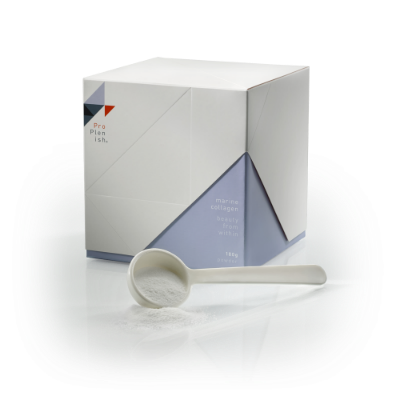
My interest in discovering more about collagen peptides and their impact on collagen and skin health led me to reach out to Proplenish, an Australian company with a single mission. ProPlenish produces edible marine collagen to help the body renew its collagen.
Proplenish is a tasteless, odourless, dissolvable powder dietary supplement and can be consumed either in juice or smoothies or just mixed in with your morning bowl of cereal or porridge.
I’ve been taking Proplenish for a couple of weeks, and it’s far too soon to tell if it’s improved my skin. The results will vary from individual to individual, depending on your overall health and skin condition. Still, the science does support the inclusion of collagen peptides as a way of improving collagen, so it might be something you’ll want to try.
Or you may prefer a vegan option, I agree. Why not tip the scales in favour of your collagen through plant-based proteins?
What is plant-based collagen?
Vollagen® is marketed as an alternative to animal-based collagen for improved skin elasticity, hair growth, and joint support, although its efficacy compared to traditional collagen still requires more extensive studies. If you’re seeking a vegan or cruelty-free option for skin and hair supplements, Vollagen® offers a substitute; however, be mindful of potential differences in bioavailability and efficacy compared to hydrolysed collagen peptides.
It’s never just one thing.
I’ve said it many, many, MANY times: when it comes to the health of your skin, it’s never just one thing. There is no magic bullet. But improving your skin from the inside is a great place to start.
Modern-day cooking methods often leave behind the valuable collagen peptides our skin needs. Adding a supplement with high-quality collagen-boosting peptides can give your skin a balanced source of amino acids, especially lysine and proline—key building blocks for collagen synthesis.
But collagen production doesn’t rely solely on amino acids. Your fibroblast cells, located in the dermis, do the heavy lifting when it comes to producing new collagen, and they need a good supply of vitamin C to function properly. Even the best peptides won’t be as effective without enough vitamin C.
If you’re considering an oral collagen-boosting peptide supplement, make sure you’re also getting enough vitamin C (ascorbic acid). While collagen peptides supply the necessary amino acids to stimulate collagen production, your fibroblast cells depend on vitamin C to do the actual work.
For more on this topic, you might find Beauty 101: Is Your Collagen Getting Enough Vitamin C? helpful. Adding a topical peptide to your routine is also an excellent idea—check out The Power of Peptides for the Skin for more insights.
Finally, remember that consistency is key. As with most things, your commitment will bring the greatest rewards.
Before trying any suggested products or another collagen-boosting peptide, it’s always wise to check with your healthcare professional first.
And now you.
Do you eat your collagen? Have you found a formula you love? I’d love to hear your story. If you’ve got a question, you can email me here.
See you next time,
